
Special Needs Furniture
#1 Special Needs Chairs for Adaptive Support and Daily Living
At EMP Living, our special needs chairs are designed to help children and adults participate more fully in everyday life, with greater independence, safety and support. With powered height adjustment, configurable postural supports, stable braking, and smooth 360-degree mobility, our REAL chairs help users participate more fully in daily activities at home, school, work, and clinical environments with more independence.
Move, Adjust, and Participate with Powered Adaptive Seating
Our powered adaptive chairs are built around the real needs of people with limited mobility, low muscle tone, developmental delays, physical disabilities, or complex seating needs. Each chair is configured around the user’s physical requirements, environment, and the activities they want and need to do each day.
Improve positioning, access, stability, and daily function with powered special needs furniture.
What Special Needs Furniture Actually Needs to Do
Special needs furniture exists because standard furniture is not designed for every body, every movement pattern, or every daily routine. Most chairs assume the user can maintain their posture, transfer independently, and adjust to different surface heights without support. For children and adults living with limited mobility, physical limitations, developmental delays, low muscle tone, or complex mobility needs, those everyday tasks may require a more supportive seating solution.
One of the challenges with many special needs furniture products is that they are designed to support a very broad range of needs with a limited number of configurations. As a result, they can be difficult to adjust, difficult to use independently, or only practical for a specific activity or environment. When adaptive equipment is cumbersome to use, people often stop using it, regardless of how well it looks in a brochure or performs during an evaluation.
When standard seating does not fit the person’s actual needs, everyday activities can become more tiring, less accessible, and more frustrating for both the user and the people supporting them. :
- A dining chair at the wrong height can make it harder to participate in meals with family and friends.
- A classroom seat without enough postural support can make it difficult for a child to focus on learning because so much energy is spent simply trying to stay upright instead of participating in the lesson.
- A standard couch or sofa may offer comfort, but it does not provide positioning, transfer support, stable braking, or easy height adjustment for a caregiver or user.
That is why special needs seating must do more than provide a place to sit. Accessible seating should help the user participate in the activity in front of them, whether that means eating a meal, attending class, working at a desk, participating in therapy, or spending time with family.
The right special needs furniture can provide the positioning, stability, accessibility, and support needed to participate more fully in everyday activities. It should adapt to the person, the environment, and the activity, rather than forcing the person to adapt around the furniture.
The best special needs furniture should not limit what a person can do. It should help make daily life more accessible, functional, and practical.
Understanding the benefits of adaptive furniture for daily life can help families, caregivers, and clinicians choose a solution that fits the person, the environment, and the activities that matter most.
Powered Special Needs Furniture: The REAL Chair
Many special needs furniture options are manual, fixed, or designed around a single activity. For example:
- Hi-lo chairs may require a caregiver to adjust the height.
- Activity chairs may support meals or classroom use, but stay in a fixed position.
- Positioning chairs may offer helpful support, but they often need someone else to adjust them when the user’s needs or activity change.
EMP Living’s REAL chairs are different because they are powered and highly configurable. The REAL Adult Chair is a powered special needs furniture designed for daily use across home, school, and work:
- Electric height adjustment can raise or lower the seat at the touch of a button.
- Powered tilt-in-space can shift the user’s position without requiring them to stand or requiring a caregiver to lift.
- The safety brake lifts the wheels off the floor to help keep the chair stable during transfers, activities, and positioning.
- Controls can be placed where they are easiest for the user to access and may include rocker switches, toggle switches, remote controls, or joystick-style controls, depending on physical needs and abilities.
This is adaptive furniture built to adjust around the person, the environment, and the activity, rather than asking people to adapt their daily lives around the furniture.
One Piece of Special Needs Furniture That Can Support Many Daily Needs
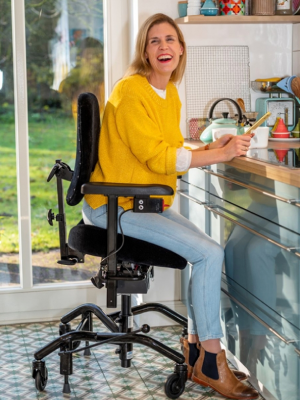
Families managing special needs furniture often end up with several separate pieces: a hi-lo chair for classroom activities, an activity chair for meals and play, a positioning chair for therapy, a lift chair for sit-to-stand support, or a transfer chair for moving between surfaces. Each piece may solve one problem, but each one also takes up space, requires adjustment, and adds complexity to daily life.
A REAL chair is designed to reduce that complexity by supporting multiple activities from one configurable seating system. The same chair can position a child at desk height for school, lower for play or rest, raise for kitchen counter access, support transfers with stable braking, and move to the dining table for mealtimes. For families, this can mean one familiar chair, one consistent support setup, and less time spent moving between different pieces of equipment.. For the user, it can mean fewer transfers, smoother transitions, and greater participation throughout the day.
Built to Order for Each User
Every piece of adaptive furniture from EMP Living is built to order. There is no single standard configuration that ships to every user. Before the chair is built, we work with the user, family, caregivers, and therapy team to select the options that best fit the user’s physical requirements, environment, and the activities they want and need to do each day.
Configuration options may include:
- Seat size and height range matched to the user’s body dimensions
- Flat or curved seat cushion and back cushion options
- Harnessing or positioning supports for users who need additional postural security
- Lateral supports for trunk control and side-to-side positioning
- Trunk supports matched to the user’s postural needs
- Headrest options for users with limited head and neck control
- Footrest style, length, and angle for lower limb positioning and access
- Pelvic support options for more stable sitting
- Armrest height, width, and style based on reach, control access, and transfer needs
The result is a chair configured around the person who will actually use it and the activities that matter most in everyday life. The full range of chair accessories for special needs can be reviewed before the consultation, helping ensure the chair is built around the user’s specific support needs, environment, and daily activities rather than adapted from a standard one-size-fits-all design.
Special Needs Furniture for Every Environment
One of the biggest frustrations with special needs furniture is that many chairs only work well in one place. A child may use a positioning chair at school, but needs a different setup at home. An adult may have the right support in a therapy setting but need something different at the dining table, desk, or kitchen counter. Each change can mean another transfer, another adjustment, or another piece of furniture.
Many special needs furniture products are designed around a single activity or environment. While they may provide excellent support for that specific purpose, they often do not adapt easily as activities, environments, or support needs change throughout the day.
REAL chairs are designed to support participation across different environments while the user remains in the same seat. The compact frame can move through standard doorways and fit under many dining tables, classroom desks, and work surfaces. Smooth-rolling wheels support movement between the kitchen, living room, bedroom, classroom, or workspace, while powered height adjustment helps match the chair to the surface in front of the user.
For families, educators, and caregivers focused on inclusion and participation, that consistency matters. The user can remain in the same chair, with the same support configuration, while participating in different activities throughout the day. Fewer transfers, fewer adjustments, and fewer disruptions can help keep the focus on the activity rather than the equipment.
For adults focused on maintaining independence with adaptive furniture, it means one chair can support more activities, more environments, and more of the moments that make up everyday life.
Who Uses Special Needs Furniture from EMP Living
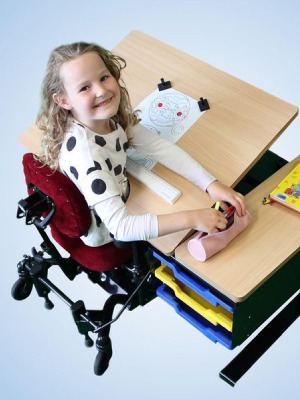
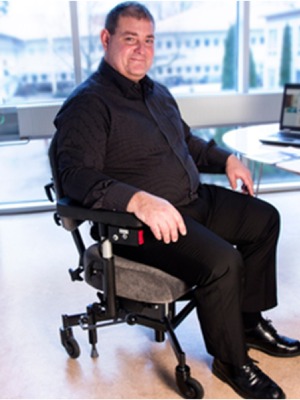
EMP Living’s special needs chairs are designed for children and adults with a wide range of physical conditions, developmental needs, mobility challenges, and daily living goals.
They may be used by many people, including:
- Children and adults with cerebral palsy who need postural support, trunk control, and positioning for daily activities at home, school, or work
- Children and adults with autism or sensory processing needs who benefit from consistent, structured seating and predictable positioning
- Adults with muscular dystrophy, multiple sclerosis, ALS, or other progressive conditions who need powered adjustment as strength, mobility, and postural control change over time
- Children with low muscle tone, developmental delays, or Down syndrome who need adaptive furniture that can be configured as their needs evolve
- Adults managing physical disabilities, stroke, spinal cord injury, or motor impairments who need powered sit-to-stand support and stable transfer positioning
- Children who need special needs furniture that supports classroom participation, learning, meals, play, and other everyday activities at home or school
- Larger users who may benefit from the REAL Big and Heavy Chair, which supports up to 605 lbs with powered height and tilt-in-space features
Occupational therapists and physical therapists recommend REAL chairs for users who need adaptive seating that supports participation, independence, transfers, and everyday activities across home, school, and work environments.
What to Look for in Special Needs Furniture
The right special needs furniture depends on the user’s physical requirements, their daily environments, and the activities that matter most to them and the people supporting them.. When comparing options, the most important features are the ones that support real daily use:
- Adjustable height: The chair should raise and lower to match the surfaces where the user spends their day. Powered height adjustment is especially useful because it can work while the user remains seated.
- Tilt-in-space: The ability to tilt the seating surface can support positioning, access, and comfort for users with postural challenges or pressure relief needs.
- Postural support options: Lateral supports, trunk supports, headrests, lumbar support, and pelvic positioning accessories should be available and configurable for the specific user.
- Stability during transfers: A reliable braking system should help keep the chair stable during transfers, repositioning, and daily activities, giving both users and caregivers more confidence.
- Durable, modular design: The user’s needs may change over time. The chair should support new accessories, supports, and configurations as those needs evolve, without requiring a complete replacement whenever possible.
- Input from an occupational therapist or physical therapist: A seating specialist can help assess the user’s postural needs, transfer needs, and daily routine before the chair is built.
At EMP Living, a free consultation helps guide this process. We work through these questions with every family before building the chair, so the configuration is matched to the user from the beginning.
Try REAL Special Needs Furniture for 30 Days
EMP Living was founded by parents who were frustrated by equipment that looked helpful but did not work well in everyday life. They needed a chair that could support their daughter through meals, school, family activities, and the countless moments that make up a normal day.
Every REAL chair is built to order and backed by a 30-day trial and EMP Guarantee. Use it in your home, school, workplace, or everyday environment, and return it for a full refund if it is not the right fit. Financing options are also available for families managing the cost of adaptive equipment.
Special needs furniture should help people do more, participate more fully, and remain independent longer. That is the standard that matters most.
Frequently Asked Questions About Special Needs Furniture
What is special needs furniture?
Special needs furniture is furniture designed for children and adults whose physical, developmental, mobility, or sensory needs are not fully supported by standard furniture. It can include adaptive seating, supportive seating, positioning chairs, hi-lo chairs, activity chairs, and powered adaptive chairs.
The goal is not just to provide a place to sit. The right special needs furniture should support posture, safety, comfort, transfers, and participation in daily activities such as meals, learning, therapy, play, work, and family life.
What is the difference between special needs furniture and regular furniture?
Regular furniture is designed for people who can sit, shift position, transfer, and adjust to fixed surface heights without much support. For children or adults with limited mobility, postural challenges, developmental needs, or physical disabilities, those everyday movements may require a more adaptive solution.
Special needs furniture provides features like adjustable height, positioning support, transfer stability, and modular accessories that can be configured around the person’s needs. The difference is not just how the chair looks or feels. It is what the furniture helps the person do, whether that means eating, learning, working, transferring, playing, or participating more independently in daily life.
Can special needs furniture be used at school and at home?
Yes. REAL chairs are designed to support use across home, school, and other daily environments while reducing the need to transfer into a different chair for every activity. The compact frame can fit through standard doorways and under many classroom desks, dining tables, and work surfaces.
Smooth-rolling wheels support movement between rooms while the user remains seated, and powered height adjustment helps match the chair to the surface in front of them, whether that is a school desk, dining table, therapy table, or activity space. For families focused on inclusion and participation, this means the user can move through different settings with the same support configuration and fewer transfers, and fewer disruptions throughout the day.
How is EMP Living special needs furniture different from catalogue options?
Every EMP Living chair is built to order for the person who will use it. Instead of choosing a stock chair from a catalogue, each REAL chair is configured before it ships, with options such as seat size, cushion system, harnessing, lateral supports, trunk supports, headrest, footrest, pelvic support, armrests, and controls matched to the user’s physical requirements, environment, and the activities they want and need to do each day.
REAL chairs are also powered. Electric height adjustment and tilt-in-space can be operated while the user remains seated, helping support access, positioning, and transfers throughout the day. Depending on the user’s needs, one configurable REAL chair may reduce the need for multiple pieces of adaptive furniture across home, school, work, or therapy settings.