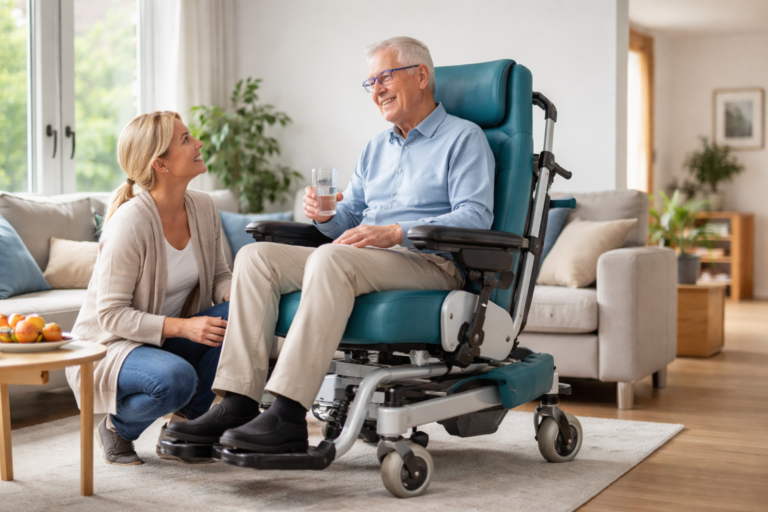
Older adults who keep sliding or slipping forward in a chair are often experiencing more than just a chair problem. In many cases, sliding out of a chair happens because of a mismatch between the seat design and the person’s posture and physical condition. Most falls and sliding out of the chair problems come from a mismatch between the person’s condition (pain, weakness, dementia, Alzheimer’s disease, Huntington’s disease, etc.) and:
- The seat size and seat depth
- Pelvic positioning
- Posture
- The back angle recline
- Foot support
When these elements are not properly aligned—especially for seniors living with pain, muscle weakness, dementia, Alzheimer’s disease, or other neurological conditions—the risk of sliding forward or falling from a chair increases. Properly designed senior seating helps maintain stable posture, improve positioning, and reduce the risk of slipping or falls.
Below is a practical, step-by-step process to stop slipping and improve comfort. Our goal is to help you reduce forward slide without creating new risks, such as pressure injuries, unsafe seat belts, or avoidable injuries.
This guide is general information, not medical advice. If falls, skin breakdown, or complex conditions (e.g., dementia, Alzheimer’s, Huntington’s) are involved, seek a seating assessment from a qualified clinician and follow facility policies.
Why Seniors Slide: Assessment, Pelvis Position & Posture
Sliding is usually caused by one (or more) of these:
- Seat too deep → the pelvis rolls back; the person scoots forward to find comfort.
- Back angle recline too open → gravity + low muscle tone = forward slide.
- No stable foot support (no footrest, wrong adjustable footplate, no footstool) → legs can’t anchor the body.
- Low friction surfaces (leather recliner, slick fabric) + poor posture control → constant slipping.
- Weak trunk control → needs lateral support (trunk laterals, arm supports) to stay midline.
- Pain, fatigue, medication effects, or cognitive impairment (common in dementia) → changing sitting behavior over time.
At EMP Living, we focus on solving the root causes of sliding and unsafe sitting through properly configured adaptive seating. Our REAL chairs are designed to stabilize the pelvis, support upright posture, and maintain secure positioning with the right combination of seat depth, back angle, and foot support. We customize seat cushions to fit each user and offer a range of accessories—such as lateral supports, armrests, seatbelts, and footrests—to help create a stable, comfortable sitting position. This personalized approach helps people sit safely for longer periods without constant repositioning, scooting forward, or slipping from the chair
Because our REAL chairs are modular, we can match the setup to the user’s needs and environment:
- Adjust seat height and tilt with an electrically powered mechanism for safer transfers
- Select the right seat size to prevent a too-deep seat
- Add stable foot support
- Dial in positioning features that reduce forward slide and shear.
The result is a more secure sitting position that protects comfort and independence, reduces caregiver workload, and lowers the risk of falls and skin issues while keeping the solution functional for daily living.
Contact us for more information
How to Fix Slipping Out of a Chair: A Step-by-Step Guide
1. Fix the Chair Setup First: Seat Height, Foot Support & Tilt
Check seat-to-floor height
When the seat is too high, the person can’t plant both feet. When it’s too low, the hips flex too much, and the pelvis may collapse backward. Aim for:
- Feet flat, knees roughly 90° (or clinician-guided)
- Hips are stable and supported
Add foot support
If the person’s feet dangle, they’ll slide fast.
- Use a stable foot support for a standard living room chair
- For clinical seating, use an adjustable footplate
- If the legs push forward, a negative-angle leg rest can sometimes help keep the pelvis positioned (best set by a seating professional)
Use lift-and-tilt appropriately
A controlled electric lift-and-tilt mechanism can help keep the pelvis back and reduce shear, whereas excessive recline often increases sliding. If you’re choosing between “more recline” and “better tilt,” tilt is frequently the more stable option (but it must be set correctly for the person’s comfort and safety).
2. Stop Slipping With the Right Cushion and Seat Surface
Choose a cushion that manages sliding and pressure
The right cushion can help, but the wrong one can make sliding worse or raise pressure risk.
Look for:
- Anti-slip top materials (high-friction cover)
- Shapes that support pelvic positioning (avoid thick pillows that push the pelvis forward)
- Pressure management features to reduce pressure injuries
Reduce low-friction surfaces
For a slick recliner:
- Add a high-friction seat cover
- Use a non-slip underlay (common household fixes exist, but don’t let DIY create bunching that increases shear)
Avoid stacking cushions as a substitute for fit
Stacking pillows is a classic substitute for proper seating. It often increases instability, raises fall risk, and makes transfers harder, especially for a senior family caregiver doing manual handling.
3. Lateral Support, Pelvis Positioning & Posture Control
Stabilize the pelvis
If the pelvis slides into a posterior tilt, the person will migrate forward. A seating clinician may recommend:
- Contoured seating
- Pelvic positioning aids
- Adjusting seat depth and back support
Add lateral support when trunk control is weak
Lateral support is often the difference between “constant slide” and “stable sitting,” especially with neuro conditions or advanced dementia. Proper trunk alignment also reduces fatigue and helps the person keep their hips back in the seat.
4. Seatbelts, Restraints & Safety Obligations
Seatbelts can be safety tools—or safety risks
Seatbelts (or positioning belts) can help maintain posture, but they must be used carefully:
- Never use belts as a casual “tie-down” solution
- Improper belt placement can increase injury risk
Consent and least restrictive care
When cognition is impaired, families can feel pressure to “secure” someone. But consent and the person’s physical independence matter. If you’re in a facility setting (or even managing complex home care), ask for professional advice and written guidance. This reduces the chance of preventable falls, complaints, and disputes about what was appropriate.
Contact EMP Living to get a seating recommendation
What to Look For in an Ideal Chair to Prevent Sliding
1. Fit and seat geometry
- Correct seat depth (not too deep) so the pelvis stays back and the person doesn’t scoot forward
- Appropriate seat width for stable sitting without drifting side-to-side
- Supportive seat surface that doesn’t let the hips sink and roll the pelvis backward
- Back support that matches the person’s posture needs (without forcing a slouch)
2. Foot support
- Feet can rest flat and supported (no dangling)
- Adjustable foot support is available when needed (footplate-style support in clinical seating or stable foot support at home)
- Foot positioning reduces pushing forward and sliding
3. Adjustability for transfers and daily living
- Adjustable seat height to support safer sit-to-stand transfers and stable sitting
- Predictable adjustments (smooth, controlled movement rather than sudden drops)
- Ability to set the chair for daily tasks (meals, hygiene, resting) while maintaining posture
4. Stability and safety
- Reliable braking or stability so the chair stays put during transfers
- Stable build quality to reduce shifting and tipping
- A “least restrictive” setup that prioritizes fixing fit and posture before adding restraints
5. Posture and trunk support
- Lateral support options if trunk control is limited
- Arm supports positioned for balance and pushing up
- Backrest support that reduces fatigue over time (especially when cognition or restlessness is a factor)
6. Cushion compatibility and pressure management
- Works with anti-slip or high-friction cushion strategies when needed
- Supports pressure management to reduce the risk of pressure injuries
- Avoids reliance on stacked pillows, which often increase instability and shear
7. Modular configuration
- The chair can be configured with the right combination of seat size, supports, and foot support
- Adjustments are practical for caregivers to manage day-to-day
- The setup can evolve as needs change over time
How to help an elderly person stand up | Safe sit-to-stand guide
EMP Living Chairs: A Long-Term Fix for Sliding
At EMP Living, we don’t provide a one-size-fits-all chair; we focus on configured adaptive seating that’s designed to solve sliding at the source. Our REAL chairs are built around seating assessment principles used in rehabilitation settings: correct seat size, controlled positioning, stable foot support, and optional posture features that help keep the pelvis back and the trunk aligned over time.
- Configured fit instead of guesswork: We match the chair setup to the person’s body, home layout, and daily routine.
- Modular support that adapts to changing needs: When posture, strength, or comfort changes, the setup can evolve, rather than forcing you to replace the chair or stack more cushions.
- Stability + safer transfers: Adjustable seat height, stable positioning, and practical support features reduce caregiver strain, especially if you’re a sole caregiver helping with sit-to-stand.
- Risk reduction without over-restraining: We prioritize least-restrictive safety and correct positioning before belts or workarounds.
Contact EMP Living for a practical seating recommendation based on your preferences, safety goals, and the person’s needs, and we’ll guide you toward a setup that’s designed to reduce sliding and improve stability over time.
Speak with EMP Living about safer seating
EMP Living chairs are backed by a 10-year warrantyon welded metal parts, a 2-year warranty on gas springs and electric actuators, and a 1-year warranty on other parts for eligible U.S. purchases through EMP Living.
Keeping the Elderly from Slipping Out of Chairs | FAQs
Is reclining the reason seniors slide forward?
Often, yes. A back angle recline that’s too open lets gravity pull the body forward. A controlled tilt and proper foot support usually stabilize posture better than adding more recline.
Do I need lateral supports for dementia or Huntington’s disease?
If trunk control is weak, lateral support can be the difference between constant sliding and stable sitting. In high-risk categories like advanced Alzheimer’s disease or Huntington’s disease, supports help maintain midline posture as fatigue and restlessness increase.
Are seatbelts safe, or are they restraints?
Seatbelts can support posture, but they can also increase injury risk if used incorrectly. Use the least restrictive option first, and seek professional advice.
What’s the difference between adaptive seating and wheelchairs?
Wheelchairs are designed primarily for mobility over distance. Adaptive seating focuses on stable sitting, posture, transfers, and daily living tasks. If the issue is sliding and fatigue rather than travel, configured seating is often the better first step.
How do EMP Living chairs help reduce sliding long-term?
EMP Living REAL chairs use a modular configuration: proper seat size, electric adjustable seat height, stable foot support, and optional posture features. This addresses root causes (pelvis position and trunk alignment) so slipping decreases without relying on improvised add-ons.